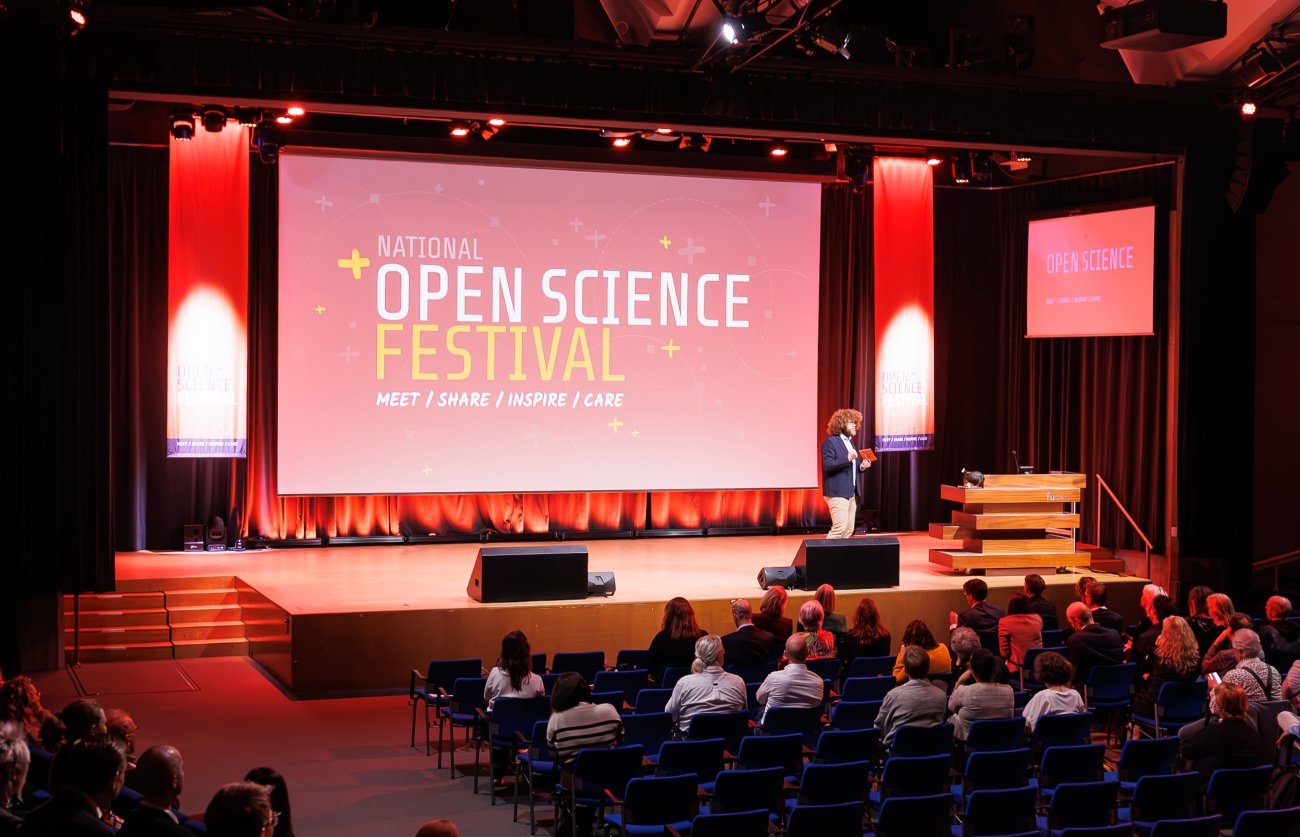
The Open Science Festival 2026 took place on 14 October 2026 at Delft University of Technology. More than 400 researchers, educators, professional research support staff and policymakers attended the event to share experiences and learn from one another about open science practices.
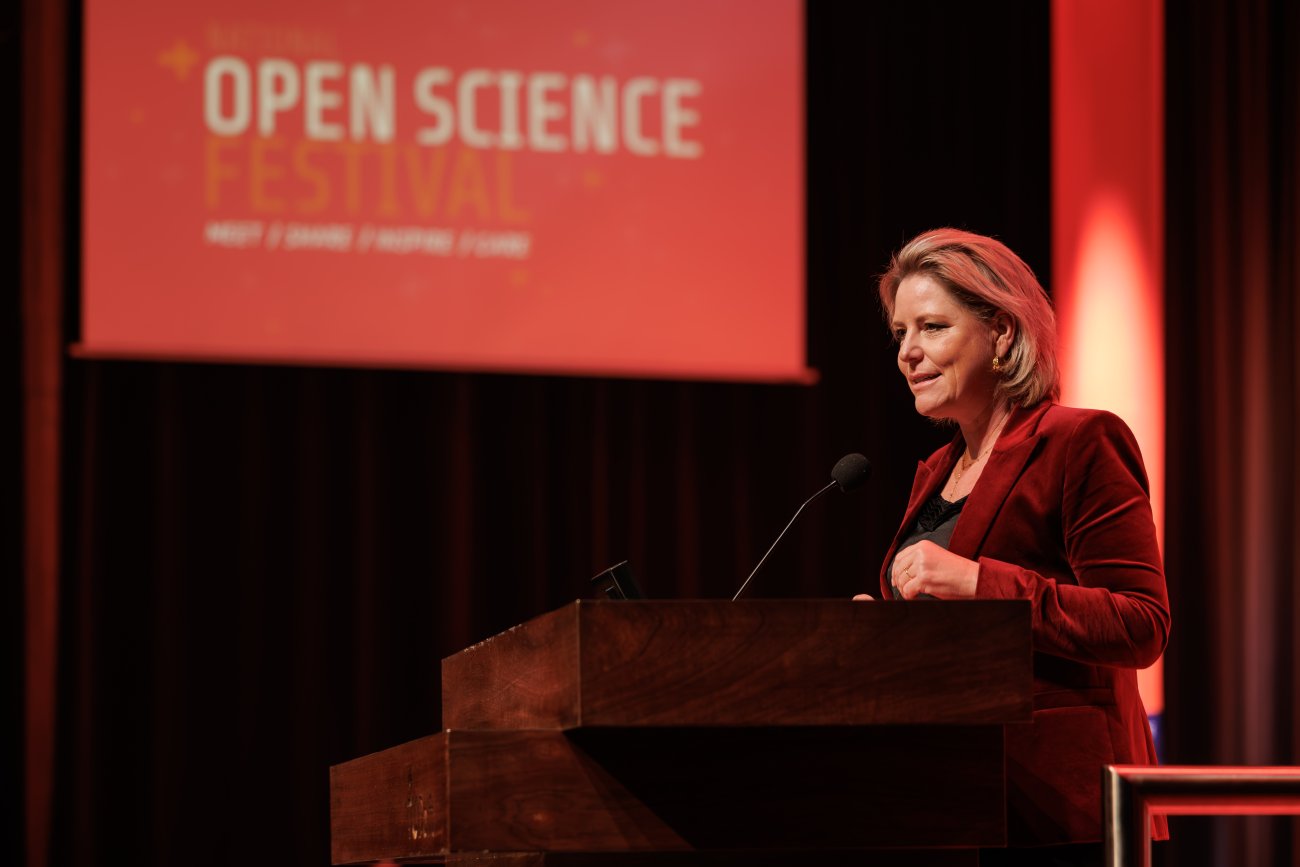
The National Open Science Festival opened with a warm welcome from Hester Bijl, Rector Magnificus of Delft University of Technology, who highlighted the importance of open science in addressing societal challenges and strengthening collaboration across disciplines.
She was followed by Rianne Letschert, Minister of Education, Culture and Science, who reflected on the growing recognition of open science within academia and society. She emphasised that the Netherlands is at the forefront of the open science movement and highlighted the importance of ensuring that research knowledge is actively shared, used and built upon. “Open science is about much more than free access to scientific publications,” she said. “It is about knowledge that we build together, that everyone can use and that others can continue to build on.” Letschert noted that this strengthens trust in science and research institutions, increases societal impact and contributes to economic prosperity.
Culture change takes time, but we can't keep using that as an excuse, we can't risk losing the trust of the community.
Photographer Robèrt Kroonen
Exploring culture, language and AI
This year’s keynote was delivered by E.M. Lewis-Jong, who explored the relationship between language, culture and artificial intelligence. While discussions around AI often focus on language representation, Lewis-Jong challenged participants to consider a broader question: how can AI systems communicate in ways that are culturally grounded? Drawing on examples from translation and localisation, the keynote highlighted the risks of cultural homogenisation in AI development and underscored the need to promote plurality and diversity throughout the AI lifecycle, from data collection and training to evaluation.
Something for everyone
Throughout the day, participants could explore a vibrant programme of sessions designed to inspire, connect and engage the open science community. Besides the various workshops, visitors were invited to browse the information market, where a wide range of organisations, projects and initiatives showcased their work and shared opportunities for collaboration. The programme also featured a series of lightning talks, offering speakers the chance to present ideas, experiences and best practices in short, dynamic presentations.
New to this year’s festival were dedicated networking sessions, creating space for participants to connect with peers, exchange experiences and spark new collaborations. Another addition was the ‘Absolutely Anything’ sessions: informal, participant-driven discussions that encouraged attendees to bring forward topics, questions or challenges of their own. Together, these activities provided ample opportunities for learning, inspiration and meaningful conversations throughout the day.
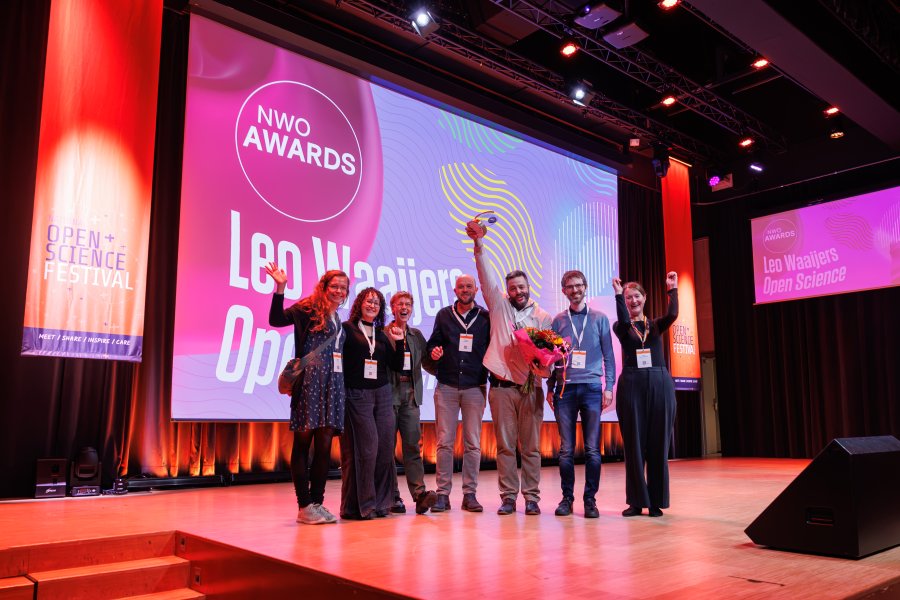
Dr Flávio Azevedo has received the NWO UKB Leo Waaijers Open Science Award 2026 for his work on FORRT (Framework for Open and Reproducible Research Training). It provides a pedagogical infrastructure and open educational resources designed to support the teaching and supervision of open and reproducible science.
Relive the festival
Relive the Open Science Festival 2026 together with the after movie and pictures.
Around 20 participants are listening to a presentation. They are seated around a number of square tables, and the presentation is projected onto a screen.
The chairperson leads the festival’s closing session, standing on the stage in the auditorium. In the background, the logo is displayed in prominent view on the projection screen.
While this year's festival has concluded, the exchange of knowledge can of course continue. Participants can now revisit the materials from workshops, posters and the information market in a dedicated Zenodo community. If you contributed a session, poster, or stand, we warmly invite you to upload your materials there, so the wider community can access and benefit from your work.
There are also Zenodo communities for the festival editions in 2025, 2023, 2022, and 2020/2021.
See you in Utrecht
The Open Science Festival 2027 will be organised in Utrecht in collaboration with Utrecht University, University of Applied Sciences Utrecht University, UMC Utrecht, and Open Science Community Utrecht.